



- Your cart is empty Browse Shop
We went back to the Moon
We Went Back to the Moon
Artemis II, April 1 to 10, 2026 — and it was just the beginning
Image: National Aeronautics and Space Administration
At 6:35 p.m. EDT on April 1, 2026, the ground shook at Kennedy Space Center's Launch Pad 39B as NASA's Space Launch System rocket hurled four human beings toward the Moon for the first time since December 1972. The crowd gathered on Florida's coast watched in near-silence, then eruption, as the Orion spacecraft, christened Integrity by its crew, punched through the atmosphere and set course for the lunar neighbourhood.
It had been a long road. The Artemis programme endured schedule slips, heat shield controversies, budget battles, and a global pandemic. But on that clear April evening, none of it mattered anymore. Artemis II was airborne.
The Numbers
| Metric | Figure |
|---|---|
| Total distance flown | 694,481 miles |
| Farthest from Earth (new record) | 252,756 miles |
| Previous record (Apollo 13, 1970) | 248,655 miles |
| Closest approach to the Moon | 4,067 miles above the surface |
| Mission duration | 10 days |
| Re-entry speed | 24,664 miles per hour |
| Photographs captured | 7,000+ (lunar surface and solar eclipse) |
| SLS thrust at liftoff | 8.8 million pounds |
Meet the Crew of Integrity
These four astronauts were not chosen for symbolism. They were chosen because they were the best. The historic firsts they carried were simply long overdue.
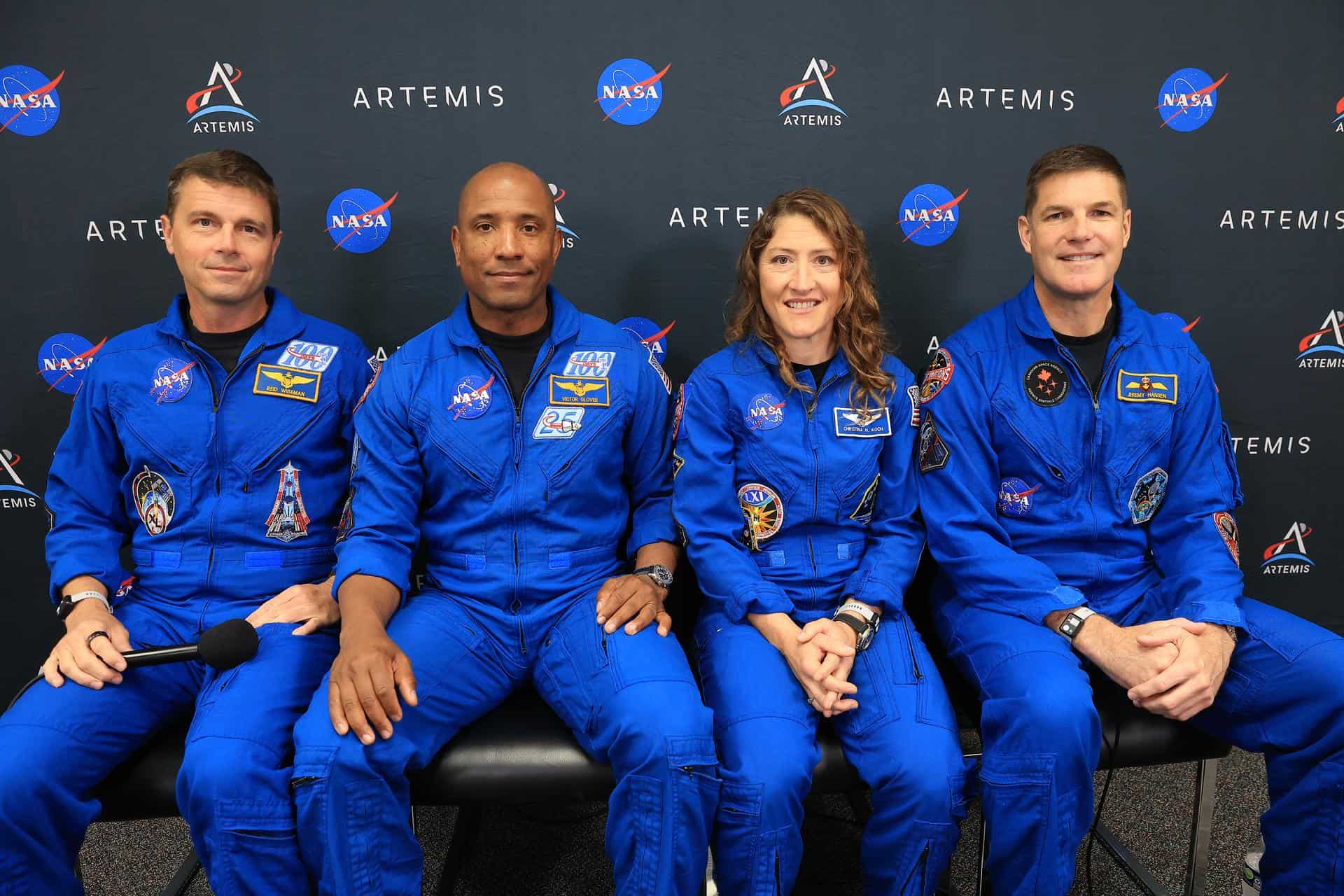
The Artemis II crew at Kennedy Space Center ahead of launch. Left to right: Jeremy Hansen, Christina Koch, Victor Glover, Reid Wiseman. Image: National Aeronautics and Space Administration
| Name | Role | Historic First |
|---|---|---|
| Reid Wiseman Commander, NASA |
Mission commander | Oldest person to travel around the Moon |
| Victor Glover Pilot, NASA |
Spacecraft pilot | First person of colour to travel beyond low Earth orbit |
| Christina Koch Mission Specialist, NASA |
Mission specialist | First woman to travel to lunar distance |
| Jeremy Hansen Mission Specialist, CSA |
Mission specialist | First non-American to travel beyond low Earth orbit |
There was also a deeply personal dimension to the mission. Commander Wiseman, a widower, was moved to tears when he spoke with his daughters from space during the mission. The crew proposed naming a lunar crater after his late wife, Carroll. Somewhere on the surface of the Moon, her name now lives in the rock.
The Mission, Day by Day
- April 1 Launch. The SLS rocket lifted off from Kennedy Space Center at 6:35 p.m. EDT. Solar array wings deployed successfully and Integrity departed Earth orbit on schedule with 8.8 million pounds of thrust.
- April 2 to 5 Deep space testing. The crew evaluated life support systems, practised manual spacecraft handling, and ran through mission-critical procedures at distances no astronaut had tested with a live crew before.
- April 6 The lunar flyby. Humanity's closest approach to the Moon since 1972. The crew swept within 4,067 miles of the surface, witnessed an Earthset and a historic Earthrise, passed through a solar eclipse where the Moon blocked the Sun entirely, and broke the all-time human distance record at 252,756 miles from Earth. More than 7,000 photographs were captured.
- April 7 to 9 The return journey. Science observations continued as Integrity began the long coast back toward Earth. Crew health studies and system debrief operations ran throughout.
- April 10 Splashdown. Orion re-entered the atmosphere at 24,664 miles per hour and splashed down in the Pacific Ocean off the coast of San Diego at 5:07 p.m. PDT. Recovery teams from NASA, the U.S. Navy, and the U.S. Air Force brought the crew safely aboard USS John P. Murtha.
The Return Journey: More Dramatic Than It Looked
The coast back from the Moon is not simply a matter of pointing a spacecraft at Earth and waiting. The re-entry phase of Artemis II carried its own very real tension.
Mission planners had originally intended a skip re-entry profile, in which Orion would briefly dip into the upper atmosphere to bleed off speed before ascending again and descending for splashdown. That plan was revised after engineers discovered unexpected erosion in the heat shield following the uncrewed Artemis I flight. The shield uses a material called Avcoat, a formulation dating back to the Apollo era, and inspections after Artemis I showed signs of cracking and divoting under re-entry heating. Rather than repeat that profile with humans aboard, NASA switched to a steeper direct entry trajectory to reduce the duration of peak heating.
⚠️ The heat shield performed successfully, but inspection of the recovered hardware began immediately after splashdown. The findings will shape the improved shield design planned for future Artemis missions.
"Twenty-four hours ago, Earth was that big out the window, and we were doing Mach 39. And here we are back at Ellington at home."
Commander Reid Wiseman, post-splashdown press conference, Ellington Field, HoustonThe numbers around the return are staggering when you sit with them. The crew travelled 694,481 miles in total across ten days. They came home at a speed that would carry them from London to New York in roughly eight minutes. And the splashdown was described by NASA officials as textbook.
Words That Will Last
Some space missions produce forgettable press conference language. This one did not.
As the spacecraft first entered the Moon's gravitational sphere of influence on the outward journey, Christina Koch radioed to mission control: "We are now falling to the Moon rather than rising away from Earth. It is an amazing milestone!"
During the flyby itself, as Earth slipped silently behind the lunar horizon for the first time in over fifty years of crewed spaceflight, Wiseman was candid about what it felt like: "I'm actually getting chills right now. Just thinking about it, my palms are sweating. It is amazing to watch your home planet disappear behind the Moon."
In that moment, the four of them paused. According to Wiseman, they shared maple cookies that Jeremy Hansen had brought from Canada. It is probably the most human detail in the history of deep space exploration.
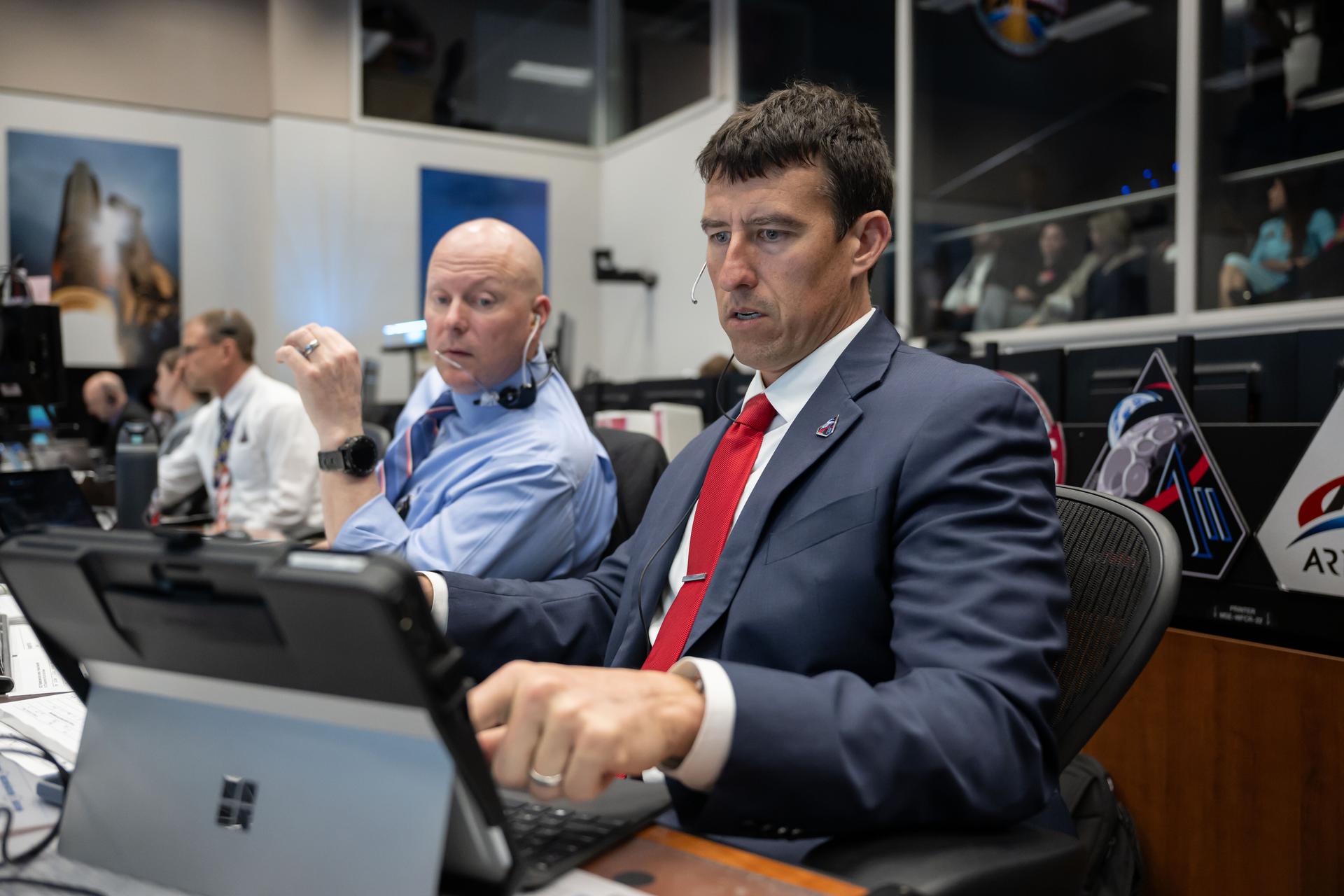
NASA flight directors Rick Henfling (right) and Judd Frieling (left) sit on console in Mission Control's White Flight Control room during NASA's Artemis II mission launch on Wednesday, April 1, 2026. Credit: NASA/Robert Markowitz
National Aeronautics and Space Administration
"Victor, Christina and Jeremy, we are bonded forever, and no one down here is ever going to know what the four of us just went through. And it was the most special thing that will ever happen in my life."
Reid Wiseman, welcome home ceremony, Ellington Field, HoustonKoch reflected on the sight of Earth appearing tiny through Orion's window: "What struck me wasn't necessarily just Earth. It was all the blackness around it." She described our planet as a lifeboat in a universe of darkness.
Her words on what it means to be part of a crew were equally striking: "A crew is a group that is in it all the time, no matter what, that is stroking together every minute with the same purpose, that is willing to sacrifice silently for each other, that gives grace, that holds accountable. A crew has the same cares and the same needs, and a crew is inescapably, beautifully, dutifully linked."
Wiseman closed the post-mission press conference with a direct appeal to the next generation of NASA astronauts in the room: "It is time to go and be ready. Because it takes courage. It takes determination. And you all are going, and we are going to be standing there supporting you every single step of the way."
The Team Behind the Mission
The four astronauts were the face of Artemis II. They were also the tip of an iceberg of extraordinary scale.
Behind every launch there are launch directors, propulsion engineers, life support technicians, software teams, trajectory analysts, and flight surgeons. There are seamstresses who stitched the spacesuits. There are welders who assembled the rocket at the Michoud Assembly Facility in New Orleans. There are antenna operators at NASA's Deep Space Network who never once lost the signal as Integrity swung around the far side of the Moon and went briefly silent. And there is an 8-year-old boy from Mountain View, California, named Lucas Ye, who won a design challenge to create the mission mascot: a small stuffed Moon wearing Earth as a baseball cap, inspired by the Apollo 8 Earthrise photograph. Commander Wiseman carried it off the capsule in a dry bag after splashdown.
💡 NASA Administrator Jared Isaacman acknowledged "the contributions of the entire NASA workforce, along with our international partners, whose expertise and commitment were essential to this mission's success."
NASA Associate Administrator Amit Kshatriya offered perhaps the most resonant line of the post-splashdown briefing: "Fifty-three years ago, humanity left the Moon. This time we returned to stay."
Johnson Space Center Director Vanessa Wyche looked toward the next generation: "We often say that we stand on the shoulders of giants, and after seeing them return from this mission, I have to say their shoulders now seem even broader for the next generation to stand on."
What Comes Next
- Artemis III (2027): A revised mission in Earth orbit to test docking with commercial landers from SpaceX and Blue Origin, and to trial the new Axiom spacesuits
- Artemis IV (target: 2028): The first crewed lunar landing since Apollo 17 in 1972
- Beyond: A sustained lunar surface presence, building toward the first crewed missions to Mars
Artemis II was always described as a test flight. By that measure it was a success on every front: life support validated, navigation confirmed, re-entry survived, crew returned healthy. Something shifted on April 1, 2026. The Moon stopped being a memory and became a destination again.
✅ The path to the lunar surface is open. "Let us finish what they started." — Amit Kshatriya, NASA Associate Administrator
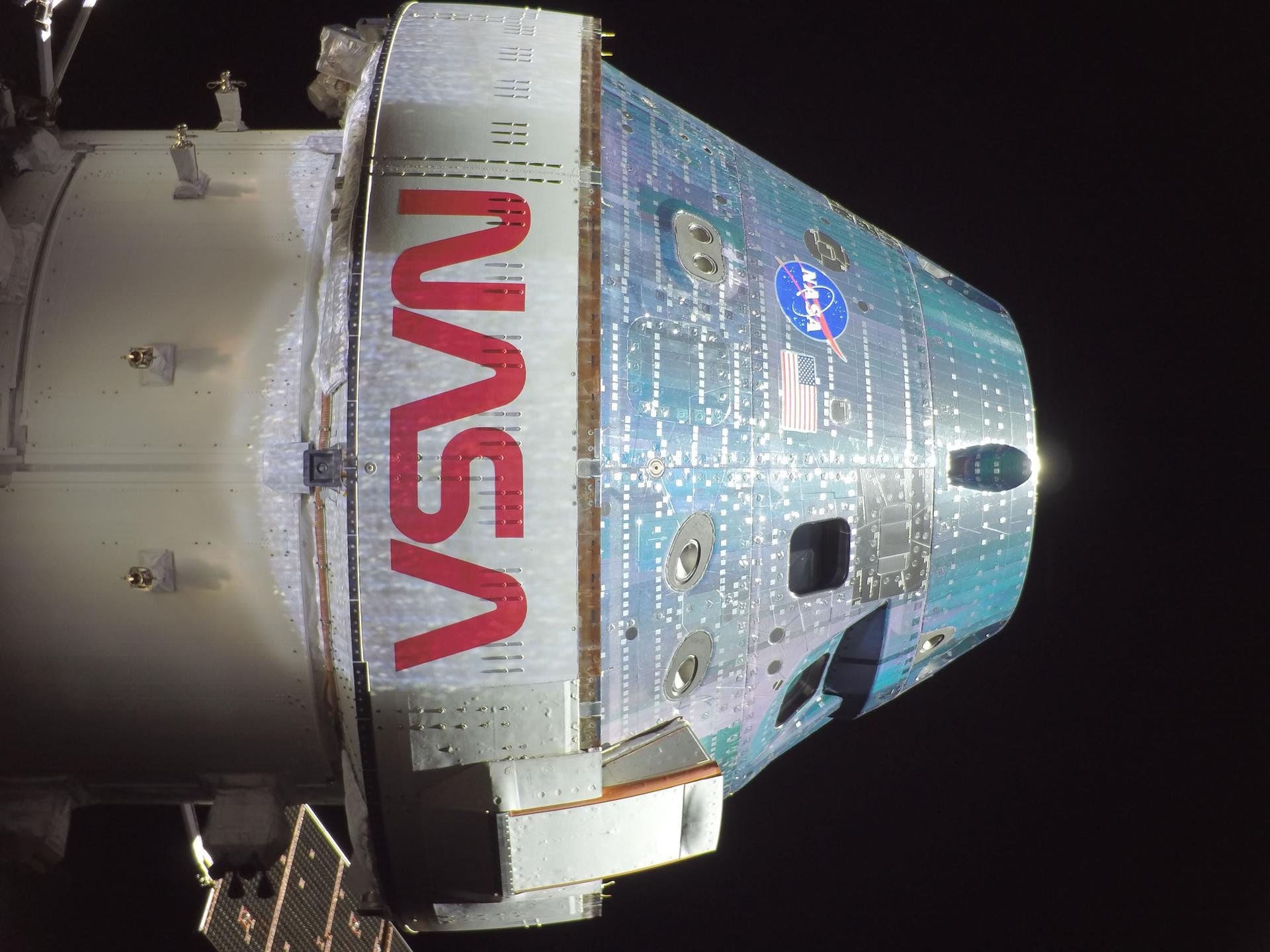
The Orion spacecraft Integrity during the Artemis II lunar flyby, April 6, 2026.
Image: National Aeronautics and Space Administration
Image: National Aeronautics and Space Administration